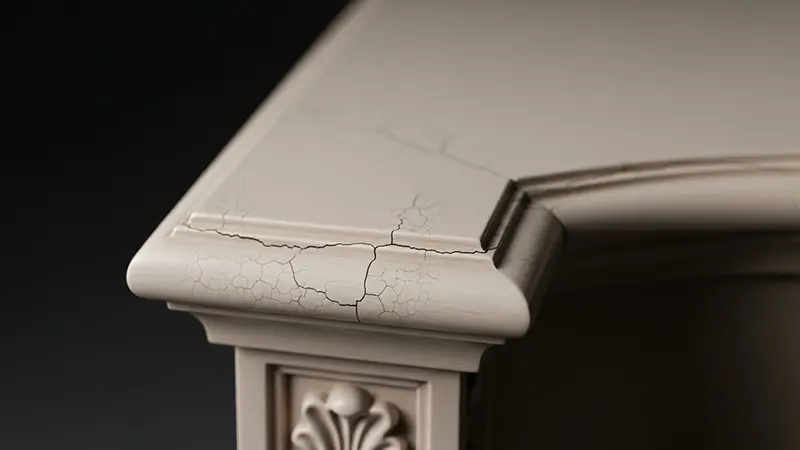
Why do some luxury console tables feel stable at first—but begin to wobble after installation or a short period of use? This is one of the most common structural concerns in slender-leg furniture systems.
01 // Cognitive Reversal
This issue is frequently observed in console tables placed against walls or in circulation areas, where even minimal lateral force exposes underlying structural instability.
Instability and lateral wobble in luxury console tables are rarely caused by the slenderness of the legs themselves. Instead, this instability is a definitive engineering failure triggered when ornamental carving interrupts the continuous load-bearing logic of the support structure. Structural collapse occurs when material removal overrides predefined force vectors.
02 // Common Buyer Evaluation Mistakes
When evaluating bespoke furniture with slender supports, buyers frequently rely on visual indicators that mask underlying structural liabilities. Common evaluation errors include:
- Assuming visual symmetry in carving equates to structural continuity within the leg shaft.
- Evaluating carving depth based on surface execution rather than calculating the remaining inner mass carrying compression.
- Overlooking the material volume at joinery nodes, mistakenly accepting continuous carving across joint envelopes where slender legs meet primary frame rails.
03 // Engineering Failure Mechanisms
Forces travel through predefined paths—from contact surfaces into the ground. When these paths are compromised, the system fails. In console tables featuring slender supports, wobbling is the direct physical manifestation of three critical mechanism failures:
- Lateral Instability Amplification: Slender support systems inherently operate with critical slenderness ratios and reduced lateral stiffness. When internal mass is removed through carving, the moment of inertia decreases, amplifying bending under minimal lateral force. This results in visible wobble even when vertical load capacity appears mathematically sufficient.
- Disruption of Vertical Compression: Console tables carry static point loads. Direct load paths must pass continuously through leg cores. When deep carving removes the inner mass, it creates structural discontinuities. The leg root sections and floor-contact bases lose their primary load core, causing microscopic deflection under weight.
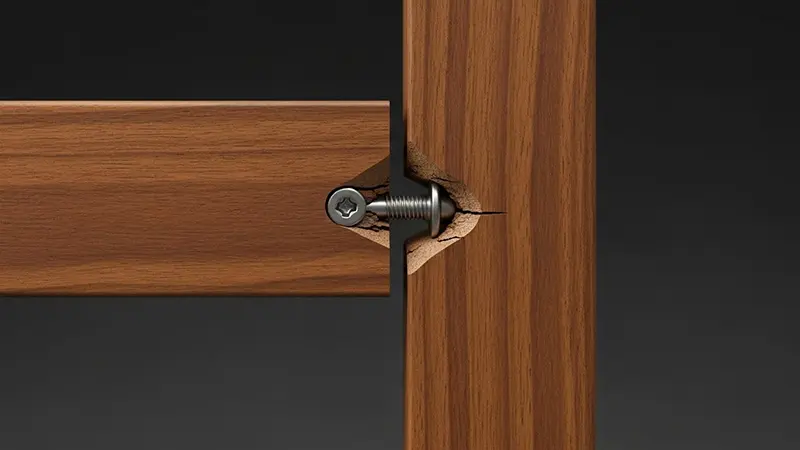
- Shear Transfer Failure at Nodes: Console tables rely heavily on leg-rail transfer to resist lateral movement. Material continuity at joinery nodes is mandatory for shear transfer. When ornamentation encroaches on the buffer zones around connections, it destroys the joint volumes, causing the mortise-and-tenon intersections to loosen under bending stress.
Responsibility is not determined by visual outcome, but by adherence to structural system boundaries. Any manufacturer applying carving within defined load paths, joint envelopes, or compression cores operates outside engineering compliance and assumes full liability for structural instability.
04 // Engineering Judgment Standards
To evaluate structural viability prior to procurement, the following mandatory core parameters must be verified against system boundaries:
- Identification of Non-Carvable Zones: Leg root sections, floor-contact bases, and primary frame rails under bending stress must remain materially intact regardless of aesthetic intent.
- Verification of Joint Envelopes: Dimensional buffer zones around connections must be mathematically protected to ensure shear transfer.
- Confirmation of Span Zones: The internal mass must be sufficient to resist long-term structural creep and deflection.
05 // System Responsibility & Action
Understanding wobble in slender furniture requires analysis beyond surface construction. Review the Load-Bearing Logic In Hand-Carved Solid Wood Furniture governing carved wood structures to identify where structural continuity must be preserved.
For a complete system-level evaluation framework and to verify manufacturer compliance, refer to the Engineering Principles Behind Bespoke Furniture Systems.