

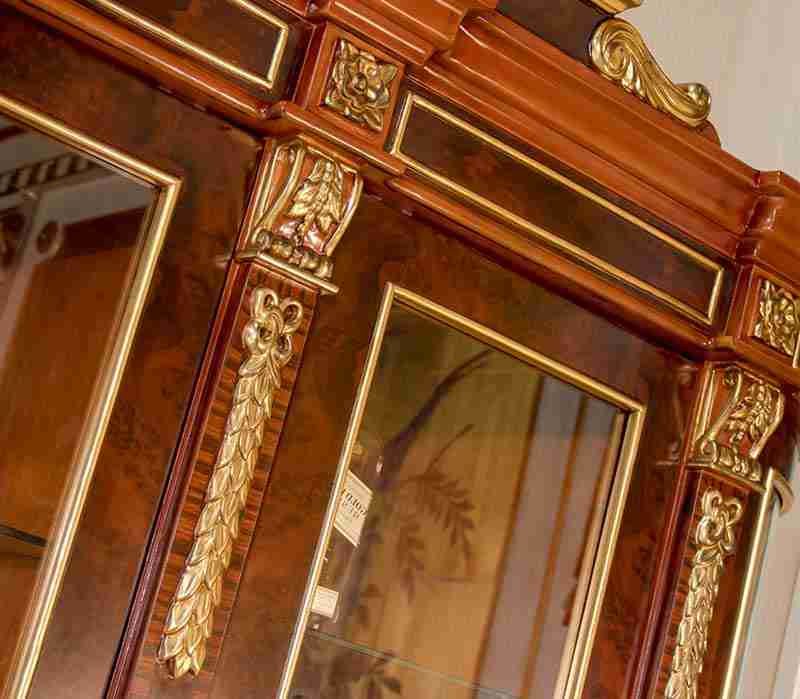

Marquetry Display Cabinet – Engineering Specification Overview
Engineering Logic
The engineering intent is to address Differential Veneer Movement within this Marquetry Display Cabinet typology.
This is achieved through the integration of the Multi-ply Birch Stabilization Matrix, which operates by neutralizing substrate expansion vectors to isolate the decorative surface.
For detailed protocols on managing multi-species expansion, refer to our analysis on differential movement management.
As a result, the risk of Differential Veneer Movement is mitigated under environmental humidity fluctuations.
Crucially, this structural density is engineered into the core matrix to limit degradation without reliance on periodic refinishing.
Marquetry Display Cabinet – Aesthetic Structure
Designed as a controlled study of proportion and material behaviour, the Marquetry Display Cabinet maintains architectural discipline.
The intricate floral marquetry on the lower panels implies a high coefficient of friction between varying grain densities; this requires a non-reactive substrate to prevent surface crazing or delamination.
This piece aligns with the systemic logic of the Imperial Palace Furniture collection.
Project-Specific Interpretation
The engineering intent is to address Differential Veneer Movement specifically for the Marquetry Display Cabinet in a Heritage Restoration context.
This is achieved through the engineered internal routing behavior of the matrix, which operates by buffering the internal matrix against stress vectors.
As a result, the risk of veneer delamination and cracking is limited under the influence of unregulated atmospheric conditions.
Construction & Material Behaviour
For this Marquetry Display Cabinet, the selected High-Gloss Veneer Assembly is bonded to a core engineered specifically for commercial stability.
- Substrate Stack: Multi-directional ply lamination for vector cancellation.
- Joinery: Reinforced mechanical connections isolating ornamented zones.
- Finish System: High-solids elasticized lacquer for thermal flexibility.
- Load Behaviour: Distributed static load transfer via reinforced base plinth.
Bespoke Manufacturing (OEM / ODM)
OE-FASHION operates as an OEM / ODM furniture engineering partner. This page represents a
capability specification.
This specification is not a stock item. Engineering feasibility, cost, and lead time are confirmed through direct consultation.
Frequently Asked Questions
A: No. This documentation defines an engineering framework. Final form, detailing, and tolerances are confirmed during the bespoke specification phase.
Q: Is this suitable for Heritage Restoration environments?
A: Yes. The system is specifically calibrated to counteract Material Compatibility forces common in these settings.
Q: Can dimensions be modified?
A: Yes. All frames are built to order, allowing for millimetre-perfect calibration.


