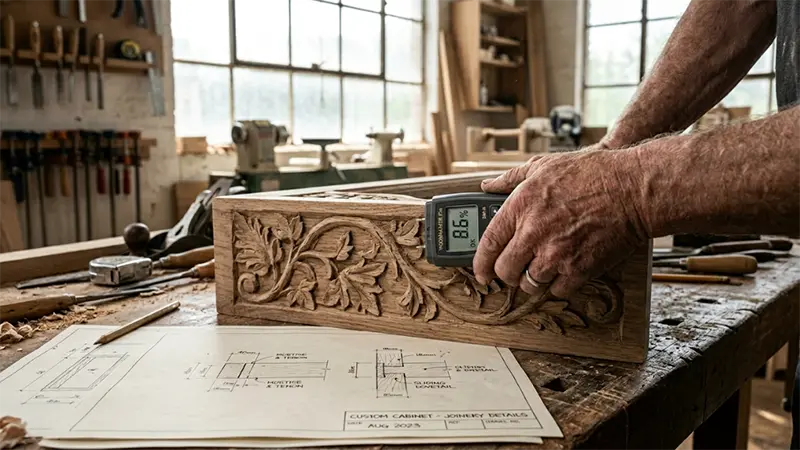
Wood Moisture Content Calibration: Preventing Joinery Failure in Bespoke Furniture
The Silent Killer: Why Moisture Content Miscalibration Destroys Bespoke Joinery
In high-end bespoke furniture, Moisture Content (MC) is the most expensive point of failure. These failures rarely appear at delivery. They emerge months later as distinct structural defects. This is not a defect of craftsmanship. It is a defect of Engineering Calibration.
The Mechanism: "Hygroscopic Equilibrium"
In solid wood engineering, Hygroscopic Equilibrium is the state where the wood's internal moisture matches the relative humidity of its environment. This is the critical variable; any deviation results in a foundational moisture content miscalibration, causing joints to open and veneers to fracture as the substrate seeks thermodynamic balance.
1. The "Delta" Problem: Factory vs. Destination
Most failures do not come from wood being "wet." They come from wood being correct for the factory—but wrong for the project.
⚠️ Standard Production
Target: 10-12% MC (Average).
Logic: Safe for local distribution.
Outcome: Disastrous when shipped to arid climates or centrally heated interiors, where wood shrinks beyond the glue's elastic limit.
✅ Bespoke Calibration
Target: 6-8% MC (Project Specific).
Logic: Destination Equilibrium.
Outcome: We force-dry the substrate to match the specific micro-climate of the installation site (e.g., New York, Dubai), ensuring zero movement.
Anatomy of Failure: The Veneer Shear
Hygroscopic Swell in Marquetry Furniture
See how differential moisture movement destroys intricate marquetry and veneer patterns.
View Engineering Document →2. The HVAC Trap: Global Logistics
The "Winter Heating" Effect: Shipping furniture from a humid workshop (60% RH) to a centrally heated penthouse in London or New York (20% RH) creates a Moisture Shock.
Planar Drift: Wide solid wood surfaces, such as large dining tables, are most vulnerable. Without precise wood movement engineering regarding surface relief and depth, these planes will "cup" irreversibly, shearing the sub-frame assembly.
- Standard: Conditioning Period: Substrates are stabilized in a climate-controlled room matching the destination target.
- Standard: The Lock Point: Assembly occurs only after the wood reaches the specific Target EMC.
- Liability: Joint separation caused by installing non-calibrated furniture into HVAC-controlled environments is a predictable engineering failure, not a "natural wood characteristic."