


WHY THIS ENGINEERING MATTERS
- Anticipates: The fracture risk inherent to “openwork” or pierced wood carvings under load.
- Stabilizes: The table edge during holiday feasts when heavy serving platters are concentrated at the perimeter.
- Delivers: A dining surface that appears delicate and floating, yet possesses the rigidity of a solid beam.
“Concerns at this scale are not aesthetic preferences — they are architectural instincts.”
In spatial compositions where furniture must operate with architectural authority rather than decorative intent, this system is designed to read as a resolved presence—visually disciplined at the primary sightline, stable at the structural logic, and fully adaptable to the spatial hierarchy of its environment.
Engineering Foresight
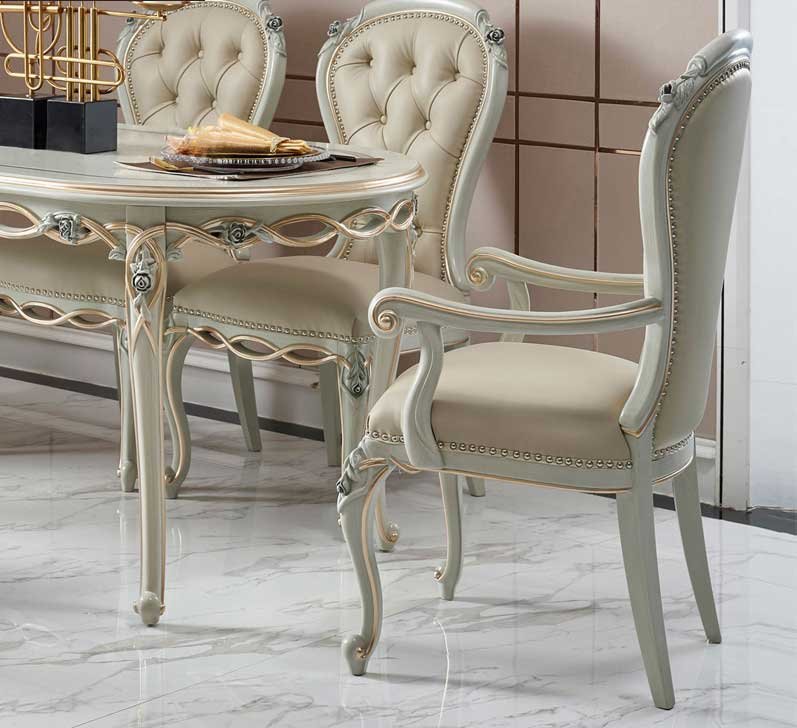
The development of this system began with the assumption that Structural Shear would eventually compromise the decorative “ribbon” (guilloche) carving on the apron. By removing material to create the pierced effect, standard carpentry weakens the beam that holds the table legs vertical. Rather than filling the negative space, the design neutralizes this force by integrating the OE-Bridge™ System.
This involves a concealed high-tensile composite rail set immediately behind the carved fascia. This internal spine carries 100% of the vertical load, allowing the carved gold ribbon to act purely as a decorative skin, free from mechanical stress.
Technically, the Neoclassical Ribbon-Carved Dining Set is conceived as a formal dining ensemble. The oval geometry is specifically calibrated to facilitate conversation flow while eliminating sharp corners in tighter circulation zones.
Project-Specific Interpretation
[SIMULATION]: In a recent commission for a Private Residence in Seoul, the design was adapted to match a specific “Celadon” ceramic collection. The lacquer finish was custom-tinted to a precise grey-green hue and cured with OE-Skin™ hardening agents. This ensured that the table surface could withstand the abrasion of unglazed ceramic foot-rings without scratching.
Structural Scalability & Upholstery Logic
The chair construction prioritizes long-duration comfort for extended dining.
- Tufting Tension: The deep button tufting on the chair backs is secured through the frame, not just the foam, preventing the leatherette from pooling or sagging after years of use.
- Leg Geometry: The Cabriole legs are cut from solid stock (not steam bent) to ensure the grain direction aligns with the load path, preventing snap-failure at the ankle.
- Nailhead Trim: Each stud is individually applied to lock the upholstery tension, rather than using decorative strips that can peel away.
Engineering Specifications (Reference)
| Structural System | OE-Bridge™ Composite Sub-Rail |
| Primary Function | Stabilization of Reticulated Carving |
| Joinery | Reinforced Corner Blocks |
| Specification Freeze | Confirmed at CAD Sign-Off |
OEM & Bespoke Services
- Full CAD & Shop Drawing Coordination
- Custom Color Matching (RAL / Pantone / Farrow & Ball)
- Leather vs. Fabric Analysis for Stain Resistance
- Contact our Atelier for Technical Specification
This is typically selected by clients who prefer to decide once — and never revisit the decision.
Technical Disclaimer: The pierced apron design requires specific handling instructions during transport. Lift points are clearly marked on the underside of the table frame.


