Grand European palace hall representing classical interior styles
The Curator's Index

European Classic
Furniture Styles

A defining guide to the four pillars of historical design. From the rational order of Neoclassicism to the fluid asymmetry of Rococo, OE-FASHION translates architectural history into bespoke furniture realities through engineered, made-to-order production.

Scroll to Explore
Curated Collections

The Four Pillars of Heritage

Style Application Overview

Private Villas · Palace Interiors · Boutique Hotels · Formal Residences · Heritage Projects

Each classical style serves different spatial scales, ceremonial demands, and architectural hierarchies.
Our atelier advises not only on aesthetics, but on suitability.

Style × Space Compatibility

Classical styles are not interchangeable decorations. Each responds differently to spatial scale, ceiling height, and ceremonial intent.

Neoclassical

  • Spatial Scale: Medium to Large
  • Ceiling Height: ≥ 3.2m recommended
  • Ceremonial Level: Formal, restrained
  • Typical Use: Villas, formal living rooms, libraries

Rococo

  • Spatial Scale: Small to Medium
  • Ceiling Height: Flexible
  • Ceremonial Level: Intimate, decorative
  • Typical Use: Private salons, bedrooms, lounges

Baroque

  • Spatial Scale: Large to Monumental
  • Ceiling Height: ≥ 4.0m essential
  • Ceremonial Level: Grand, authoritative
  • Typical Use: Palatial halls, hotel lobbies, ballrooms

Imperial

  • Spatial Scale: Large, axial layouts
  • Ceiling Height: ≥ 3.5m recommended
  • Ceremonial Level: Official, monumental
  • Typical Use: State rooms, formal residences, studies

Selecting an unsuitable style for a given space often results in visual overload or loss of authority. Our role is to prevent that.

Define Your Bespoke Direction

A classical style is not a visual preference —
it defines proportion, ornament logic, fabrication sequence, and review milestones.

This module defines the engineering direction of your project —
not a stylistic preference or catalog selection.

Neoclassical Direction

Order · Proportion · Structural Clarity

Project Characteristics

  • Emphasis on architectural symmetry and rational proportion
  • Moderate ornament density governed by geometry
  • Highly controlled joinery and alignment precision

Execution Implications

  • Earlier dimensional lock-in
  • Fewer carving revision cycles
  • Strong CAD-to-fabrication dependency

Rococo Direction

Asymmetry · Movement · Sculptural Detail

Project Characteristics

  • Fluid, non-repetitive carving language
  • Deep relief sculpting and freeform motifs
  • Ornament dominates visual hierarchy

Execution Implications

  • Extended hand-carving timelines
  • Additional mid-production review gate
  • Ornament approval precedes finishing logic

Baroque Direction

Monumentality · Drama · Authority

Project Characteristics

  • Large-scale compositions and axial symmetry
  • Heavy gilding and high visual weight
  • Furniture functions as architectural focal points

Execution Implications

  • Structural engineering prioritized before ornament
  • Extended dry-fit and load validation
  • Higher tolerance control at assembly stage

Imperial Direction

Discipline · Geometry · Permanence

Project Characteristics

  • Rectilinear forms and architectural restraint
  • Emphasis on proportion over decoration
  • Material authority (mahogany, bronze, ormolu)

Execution Implications

  • Early material confirmation
  • Strict aesthetic lock before fabrication
  • Fewer but irreversible decision gates

Classical Styles in
Contemporary Contexts

Classical furniture was never meant to exist as isolated objects. In contemporary projects, historical styles must be translated — not replicated.

Our atelier adapts classical languages to modern architecture by controlling scale, ornament density, and material expression.

  • Ornament is applied selectively, never continuously
  • Architectural proportion governs all decorative decisions
  • Historical motifs are expressed through craftsmanship, not excess
Design Constraints

When Classical Styles
Should Not Be Used

Classical furniture carries architectural and ceremonial weight. Applied incorrectly, it can overwhelm a space, distort proportions, or conflict with the intended function of an interior.

Our role is not to impose a style, but to advise restraint when a historical language does not serve the architecture.

  • Rococo Detailing

    Unsuitable for large, highly symmetrical corporate spaces where gravity is required.

  • Baroque Compositions

    Require sufficient ceiling height and spatial hierarchy; fail in compressed volumes.

  • Imperial Forms

    Appear rigid and alienating in informal or intimate residential-scale interiors.

  • Excessive Ornamentation

    Can weaken architectural clarity rather than enhance it, creating visual noise.

Strategic Curation

Style Selection by
Project Typology

Beyond aesthetics, classical styles respond differently to scale, circulation, and hierarchy. Below is a curatorial guideline based on architectural provenance.

Private Villas

Neoclassical / Imperial

Restrained compositions offer balance, clarity, and long-term livability. Focus on human scale rather than monumentalism.

Palace & Formal

Baroque / Grand Imperial

Styles that support grandeur, procession, and ceremonial spatial narratives. Requires high ceilings and strong axial symmetry.

Boutique Hotels

Rococo / Eclectic

Ornament is applied selectively for intimacy and sensory richness. Designed for "guest experience" and visual differentiation.

Heritage Restoration

Context Driven

Selection is strictly governed by historical context, archival reference, and the architectural provenance of the site.

* These are curatorial starting points. Final decisions must always respond to specific architectural constraints.

On Mixing & Transitioning Styles

Classical styles are not interchangeable decorative layers. While hybrid compositions are possible, they must strictly respect architectural hierarchy and visual dominance. In most projects, one primary style should remain dominant, with secondary influences applied selectively.

Style decisions are guided by structure and proportion first.
Ornament follows architecture, not the reverse.

The Neoclassical Style

Order, Proportion & Rational Beauty

Neoclassicism emerged in late 18th-century Europe as a return to architectural discipline, rejecting excess in favor of clarity, symmetry, and proportion. It treats furniture not as decoration, but as architectural structure within a space.
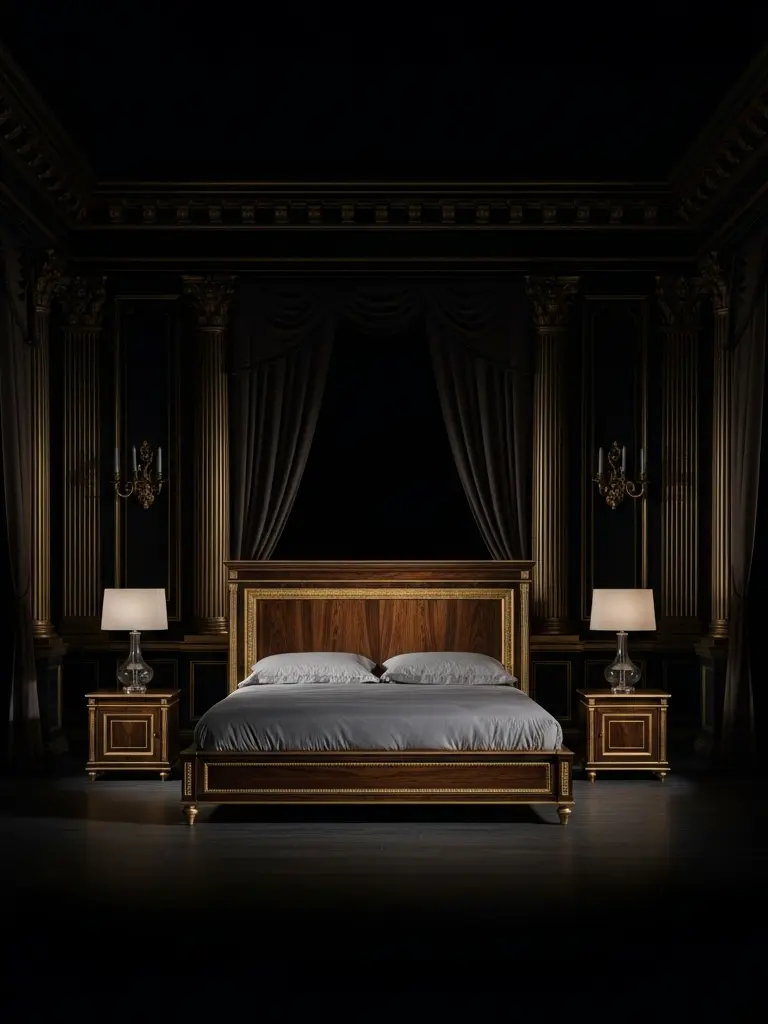
  • Motifs: Columns, fluted pilasters, laurel wreaths.
  • Form: Symmetrical, rectilinear, architecturally scaled.
  • Mood: Calm, intellectual, and enduring.
Neoclassical interior with symmetrical furniture and classical columns

The Rococo Style

The Poetry of Asymmetry (Louis XV)

Emerging in 18th-century France, Rococo rejects the heaviness of Baroque in favor of lightness, grace, and asymmetry. It is characterized by the "Rocaille" (shell) motif and fluid curves.

  • Motifs: Shells, acanthus leaves, floral garlands.
  • Form: Cabriole legs, serpentine fronts, no straight lines.
  • Mood: Romantic, intimate, and fluid.
Hand-carved French Rococo furniture detail with shell motifs

The Baroque Style

The Theater of Grandeur (Louis XIV)

Baroque is the art of absolute power. Defined by bold contrasts, heavy gilding, and dramatic movement. It is furniture designed to impress and dominate a space.

  • Motifs: Putti (cherubs), lions, heavy scrolling foliage.
  • Form: Massive proportions, twisted columns, symmetry.
  • Mood: Masculine, dramatic, and opulent.
Italian Baroque furniture with heavy gold leaf and dramatic carving

The Imperial Style

The Architecture of Power (Empire)

Returning to the purity of ancient Rome and Greece, the Empire style creates a sense of order and permanence. It features geometric forms, architectural columns, and exotic mahogany veneers.

  • Motifs: Laurel wreaths, eagles, sphinxes, columns.
  • Form: Rectilinear, symmetrical, block-like feet.
  • Mood: Intellectual, disciplined, and majestic.
Empire style furniture with architectural columns and symmetry
The Translation Logic

From Style Reference
to Bespoke Execution

At OE-FASHION, classical styles are not fixed templates but reference frameworks. Each commission begins by translating a chosen style into project-specific parameters: spatial scale, functional use, and material hierarchy.

The final outcome is not a replica of history, but a calibrated interpretation shaped by your project.

Curatorial Inquiries

Can I mix different styles (e.g., Rococo & Neoclassical)?
Yes. We can adjust wood finishes and fabrics to create harmony between different eras. View our Project Portfolio to see successful eclectic interiors.
Can you replicate a specific antique design?
Absolutely. Send us a photo of a museum piece or auction item. Our Master Carvers can reproduce the ornamentation with high fidelity.
What fabrics best suit the Empire style?
Empire favors structured silks and heavy velvets in deep tones (Royal Blue, Emerald, Crimson), often with embroidered laurel or bee motifs.
Is the finish real gold leaf or paint?
We strictly use traditional Water Gilding with 24K gold leaf. This provides a depth and luster that metallic paint cannot achieve. Learn about our Finishing Process.
Can dimensions be adjusted for modern rooms?
Yes. We re-scale historical proportions (e.g., height of armoires, headboards) to fit modern luxury villa ceiling heights without losing visual balance.
Do you provide wood finish samples?
Yes. We express mail physical samples of wood stains, patina, and gold leaf to ensure they match your existing interior palette.

Create Your Signature Interior

History provides the template. You provide the vision.

At OE-FASHION, we do not simply replicate history; we adapt it. Whether you desire the drama of Baroque with modern velvet upholstery, or the restraint of Empire with custom dimensions.

Scroll to Top