WHY THIS ENGINEERING MATTERS
- Anticipates: The tendency of pedestal furniture to “wobble” or drift under asymmetric loading.
- Stabilizes: The display platform even when loaded with heavy porcelain collections on upper shelves.
- Delivers: A static architectural sculpture that secures high-value artifacts.
“Concerns at this scale are not aesthetic preferences — they are architectural instincts.”
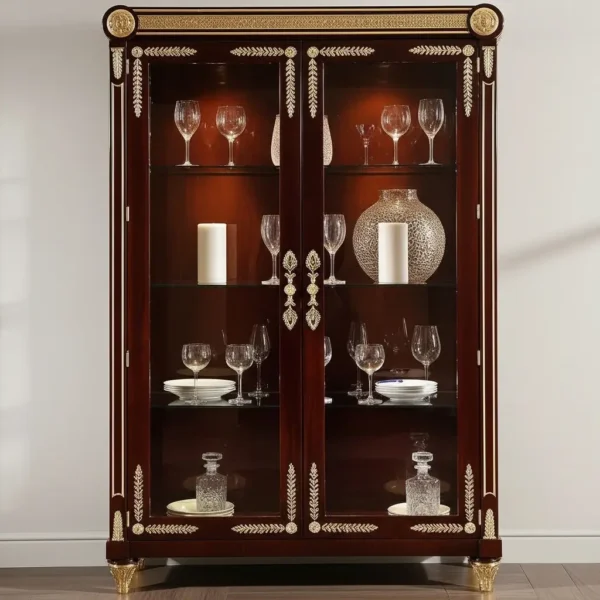
In spatial compositions where furniture must act as a sculptural focal point, this cabinet is designed to read as a resolved presence. The Imperial Collection prioritizes the vertical continuity of the Baroque Gold Leaf detailing, ensuring that the dramatic silhouette is backed by a rigid internal skeleton.
Engineering Foresight
The development of this system began with the assumption that Pedestal Torque (lateral movement at the top) would eventually compromise the safety of the contents. In traditional joinery, the narrow connection between the base and the body is a weak point. Rather than relying on wood glue alone, the design neutralizes this force by integrating an OE-Spine™ Steel Core that runs from the floor plate through the U-shaped arms and into the cabinet header.
This intervention interrupts the failure path. The result is a monolithic structure that eliminates vibration and sway, protecting the delicate contents within.
Technically, the Imperial Gilt Wood Display Cabinet is conceived as a specialized artifact preservation system. Categorically defined as a solitary showpiece rather than modular wall storage.
Project-Specific Interpretation
[SIMULATION]: In a recent commission for a Private Collector’s Gallery, the design was adapted to house antique horology (clocks). Despite the vibration sensitivity of the mechanisms, the system provided a completely inert platform. As seen in our luxury portfolio, the integration of the OE-Lock™ door system ensured that the dust seal remained airtight, reducing maintenance intervals for the collection.
Structural Scalability & Silhouette Logic
The support logic utilizes the U-Shaped Cantilever Principle. The heavily carved acanthus arms are not merely decorative; they act as diagonal braces (struts) that distribute the cabinet’s weight evenly across the pedestal footprint.
Material Contrast & Optics
The visual hierarchy is established by the contrast between the White Lacquer body and the Dark Mahogany door frames. This “frame-within-a-frame” technique draws the eye inward to the display, while the mirrored back panel amplifies ambient light, ensuring the artifacts are illuminated from all angles without requiring internal wiring.
Engineering Specifications (Reference)
| Structural System | OE-Spine™ (Steel/Timber Composite) |
| Primary Function | Neutralization of Torque/Wobble |
| Joinery | OE-Lock™ Reinforced Dowels |
| Gilding | 24k Gold Leaf (Double Weight) |
| Specification Freeze | Confirmed at CAD/Sample Sign-Off |
OEM & Bespoke Services
- Full CAD & Shop Drawing Coordination
- Custom Height Scaling (Ceiling Alignment)
- Interior Fabric Lining Options (Velvet/Silk)
- Initiate Bespoke Specification
This is typically selected by clients who prefer to decide once — and never revisit the decision.
Technical Disclaimer: While internally weighted for stability, floor levelling is critical during installation. We provide adjustable levellers within the plinth base to accommodate uneven stone flooring.
Frequently Asked Questions
Q: Can lighting be added inside?
A: Yes. We can route low-voltage LED channels into the header, though the mirrored back often provides sufficient illumination in well-lit rooms.
Q: Is the glass shatter-proof?
A: We use 6mm tempered safety glass for all vertical glazing and shelving to meet commercial safety codes.
Q: How is the gold leaf maintained?
A: Dust lightly with a soft brush. Do not use liquid cleaners on the gilded areas.