


WHY THIS ENGINEERING MATTERS
- Anticipates: The tendency of radial veneers to separate at the “hub” (center point) due to wood movement.
- Stabilizes: The table geometry against leg splay via the integrated lower structural diaphragm (shelf).
- Delivers: A static architectural centerpiece that withstands the micro-climate shifts of large open-plan salons.
“Concerns at this scale are not aesthetic preferences — they are architectural instincts.”
In spatial compositions where the centre of the room commands the visual hierarchy, this table is designed to read as a resolved anchor. The Baroque Gold Leaf Series prioritizes the longevity of the surface art, ensuring that the complex interplay of exotic wood veneers is preserved by a scientifically balanced core structure.
Engineering Foresight
The development of this system began with the assumption that Centripetal Expansion would eventually compromise the central rosette of the marquetry. In traditional solid wood tables, the “pie-slice” arrangement of veneers fights against itself during humidity changes, leading to cracks. Rather than risking this failure, the design neutralizes this force by bonding the veneers to an OE-Disc™ Substrate—a marine-grade, cross-laminated core that is inert to atmospheric changes.
This intervention interrupts the failure path. The result is a high-gloss surface that retains its glass-like continuity without “telegraphing” substrate seams.
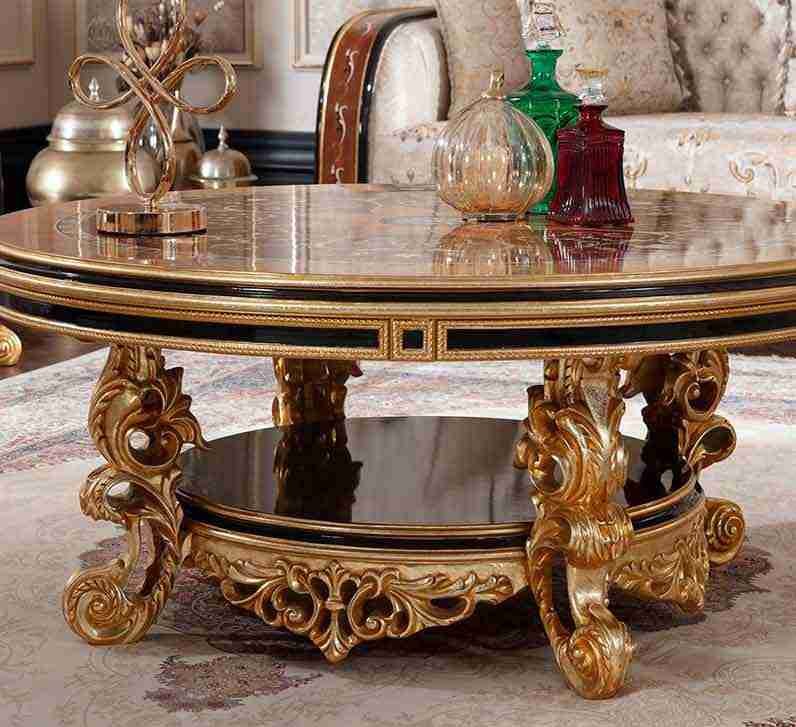
Technically, the Baroque Marquetry Round Coffee Table is conceived as a centralized surface platform. Categorically defined as a high-load low table suited for heavy decorative objects (vases, sculptures).
Project-Specific Interpretation
[SIMULATION]: In a recent commission for a Luxury Hotel Lobby, the design was adapted to resist surface abrasion from frequent guest use. The marquetry was sealed beneath a High-Build Polyester Lacquer, providing a lens-like depth while acting as a sacrificial wear layer. As demonstrated in our project portfolio, the lower shelf was reinforced to support heavy coffee table books, effectively acting as a structural tie-bar that prevents the carved legs from loosening over time.
Structural Scalability & Base Logic
The support logic utilizes a Triangulated Load Path via the ornate cabriole legs. Crucially, the lower shelf is not merely decorative; it functions as a structural diaphragm that locks the legs in position, preventing the “wobble” common in tables that rely solely on top-plate connections.
Marquetry & Surface Protocol
The surface is a study in material contrast. We utilise a “sand-shading” technique on the floral inlays to create depth before sealing. The surrounding frame features a Black Lacquer finish with 24k Gold Leaf highlights, creating a high-contrast boundary that visually frames the wood art.
Engineering Specifications (Reference)
| Structural System | OE-Disc™ (Inert Composite Core) |
| Primary Function | Neutralization of Veneer Checking |
| Joinery | OE-Lock™ Reinforced Dowels |
| Surface Hardness | >4H (Polyester Lacquer) |
| Specification Freeze | Confirmed at CAD/Sample Sign-Off |
OEM & Bespoke Services
- Full CAD & Shop Drawing Coordination
- Custom Veneer Selection (Walnut, Ebony, Rosewood)
- Dimension Scaling (900mm to 1800mm Dia)
- Initiate Bespoke Specification
This is typically selected by clients who prefer to decide once — and never revisit the decision.
Technical Disclaimer: Coasters are recommended to preserve the lacquer clarity. Direct exposure to continuous sunlight may cause veneer patina to shift over 10+ years (UV filters available upon request).
Frequently Asked Questions
Q: Can the pattern be changed to a geometric design?
A: Yes. We can laser-cut any vector pattern into the marquetry surface to align with rug motifs or ceiling details.
Q: Is the gold leaf durable?
A: We apply a protective clear coat over the gilding to prevent oxidation and abrasion during cleaning.
Q: How is the table crated?
A: The table is crated fully assembled in a suspended foam cradle to protect the legs and high-gloss surface.


