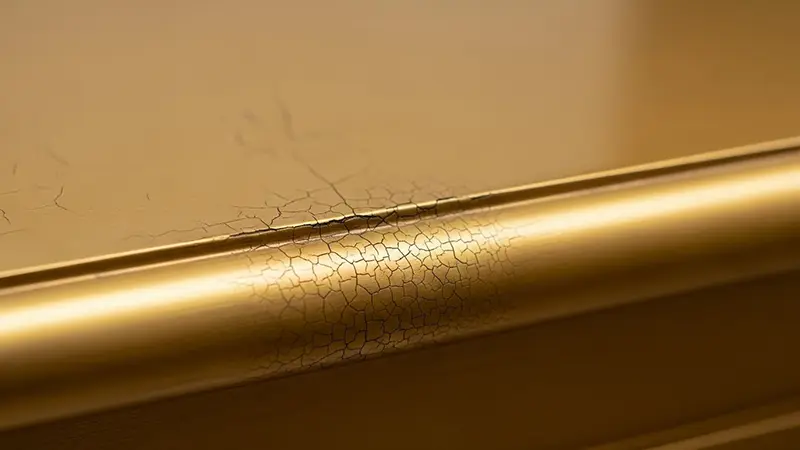
Gold leaf failure is rarely caused by the gold itself. It is almost always a symptom of substrate failure. In modern luxury estates, this decoupling is most often triggered by the aggressive thermal gradients of radiant heat systems, which attack the bond between the inert metal skin and the breathing wood core.
The Mechanism: "Differential Expansion"
In gilded joinery, Differential Expansion describes the conflict between the hygroscopic movement of the wood base and the static rigidity of the gold layer. When radiant heat accelerates moisture loss, the resulting dimensional change creates a kinetic mismatch. Without an engineered buffer, this leads to immediate structural failure at the glue line, causing the gold to fracture and flake off.
1. The Shear Stress Problem: Metal vs. Wood
The fundamental conflict is physics: Wood moves; Gold does not.
⚠️ The Paint Illusion
Material: Standard Polymer Paint.
Physics: Paint is elastic. When wood swells, paint stretches.
Gold Reality: Gold leaf has Zero Tensile Elasticity. If the wood moves even 1%, the gold shears off instantly.
✅ The Buffer Solution
Material: Traditional Gesso (Chalk + Rabbit Skin Glue).
Physics: A multi-layer "Shock Absorber."
Result: Isolates the static gold from the moving wood, preventing micro-fractures for decades.
Engineering the Surface Stack
Finish Layer Stack-Up & Optical Flatness
See the cross-section analysis of our 7-layer gilding system compared to standard spray finishes.
View Engineering Document →2. Failure Point: The Porosity Trap
The "Sponge Effect": Even the best gesso cannot save a bad substrate. Woods like Rubberwood or open-grain Oak act like sponges, absorbing humidity rapidly.
The Protocol: We mandate the use of European Beech. Its tight, diffuse-porous grain structure creates a stable, inert platform that minimizes hygroscopic movement, protecting the fragile gold layer above.
- Standard: 4-6 coats of traditional Gesso are mandatory before Bole application.
- Exclusion: We reject "Direct-to-Wood" gilding and acrylic primers for heavy carved items.
- Liability: Gilding delamination caused by substrate swelling in softwoods (e.g., Pine/Rubberwood) is a predictable material failure, not a finish defect.